Polar Cycle
The Great Year — 25,920-Year Celestial Rhythm
Every 25,920 years, Earth's polar axis traces a full circle across the northern sky. This celestial cycle is known as Axial Precession — or, as Plato called it, the Great Year. This grand rhythm governs the planet's climate shifts and shapes the rise and fall of civilizations. In response, we forged the Polar Chrono — the very foundation of our time engine — to explore, map, and explain the epic stories of humanity.
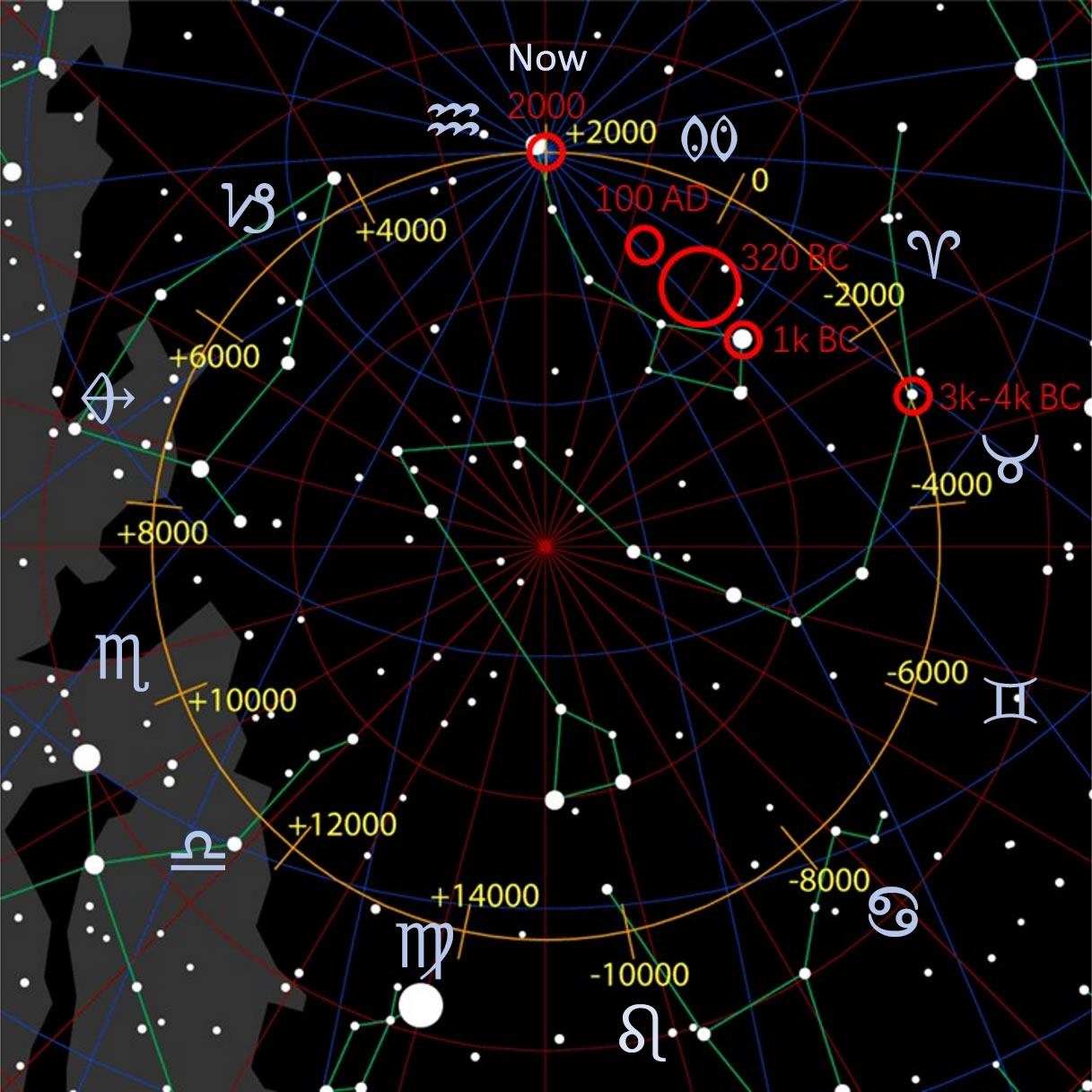
Polar Sky Map (Constellation of the North Star)
The North Star is the brightest star in the Northern Hemisphere and the constellation of the Little Bear. It is located at the tail of the Little Bear constellation and is about 434 light-years away from Earth.
As the North Pole completes its 25,920-year circuit around the celestial north pole, the twelve constellations of the ecliptic also circle the Earth — each lasting 2,160 years — shaping the development of earthly civilizations along the way.
Frequently Asked Questions
What is Axial Precession (the Great Year)?
Axial precession is the slow wobble of Earth’s rotation axis, cycling roughly every 25,920 years — called the Great Year by Plato.
How are the Polar Chrono, Gaia and Zi Wei related?
In our framework, the Western "Gaia" and the Chinese "Zi Wei (Purple Forbidden Star)" both point to the same North-Pole axis — two cultural expressions of one cosmic axis.
How are the Nine Stars linked to the Enneagram?
We map the Nine Stars of the Dipper (seven visible, two hidden) onto the Enneagram, letting users understand their guardian star through a familiar personality framework.
Is the Polar Chrono a religion or prediction?
No. We explore "stellar history research" and "spatial resonance technology", using astronomical and archaeological evidence to examine humanity’s shared cosmic heritage.